Thirty Videos In and Nothing Moved: How to Audit a Stalled Channel
There was a stretch early on where I believed the only missing ingredient was volume. Upload enough, and the system would eventually notice. I got past thirty videos on that theory. Growth stayed almost perfectly flat.
What I had wrong was the unit of measurement. I was grading myself on videos. The platform was grading a channel.
If your uploads are stacking up and nothing is moving, more uploads is rarely the fix. What usually helps is an audit – reading your own channel the way a stranger’s recommendation system reads it, and finding the places where it contradicts itself.
The question being asked about your channel
Distribution comes down to one practical question: who should be shown this, and why them?
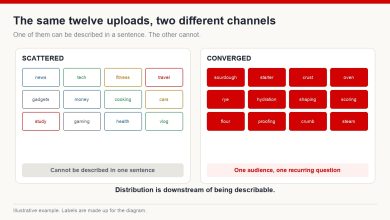
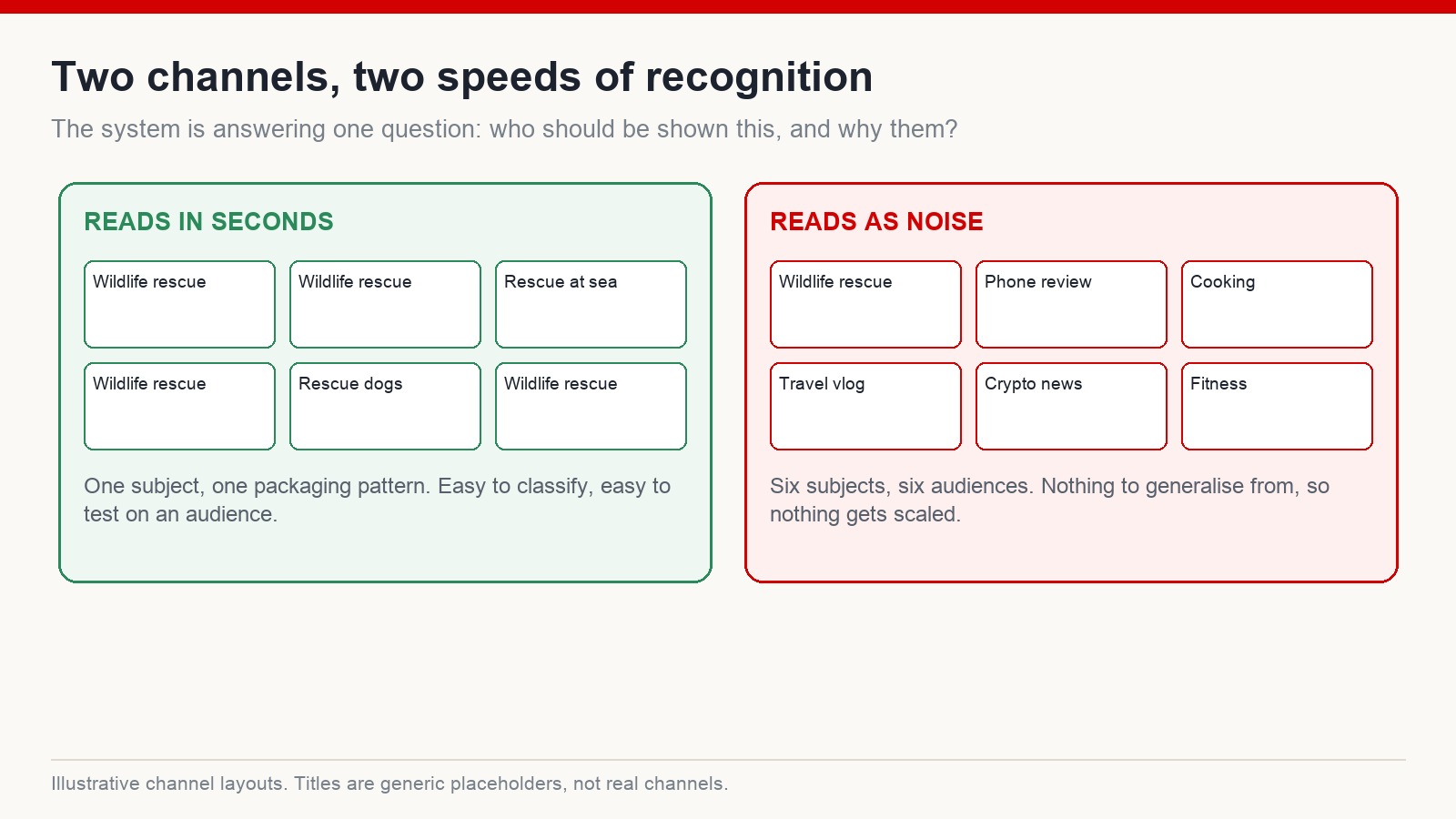
Every element on your channel is an input into that answer. The name. The topic mix. The thumbnails. The title style. The upload rhythm. What viewers do after they click. When those inputs agree, the answer arrives quickly and the channel starts getting shown to a coherent group of people. When the inputs disagree, the answer stays fuzzy, and a fuzzy channel gets tested cautiously and rarely scaled.
That is the whole diagnosis in one line. A stalled channel is usually not a bad channel. It is an unreadable one.
The seven signals worth auditing
Open your own channel page in a logged-out window, so you see it without the warm glow of your own watch history. Then go through these in order.
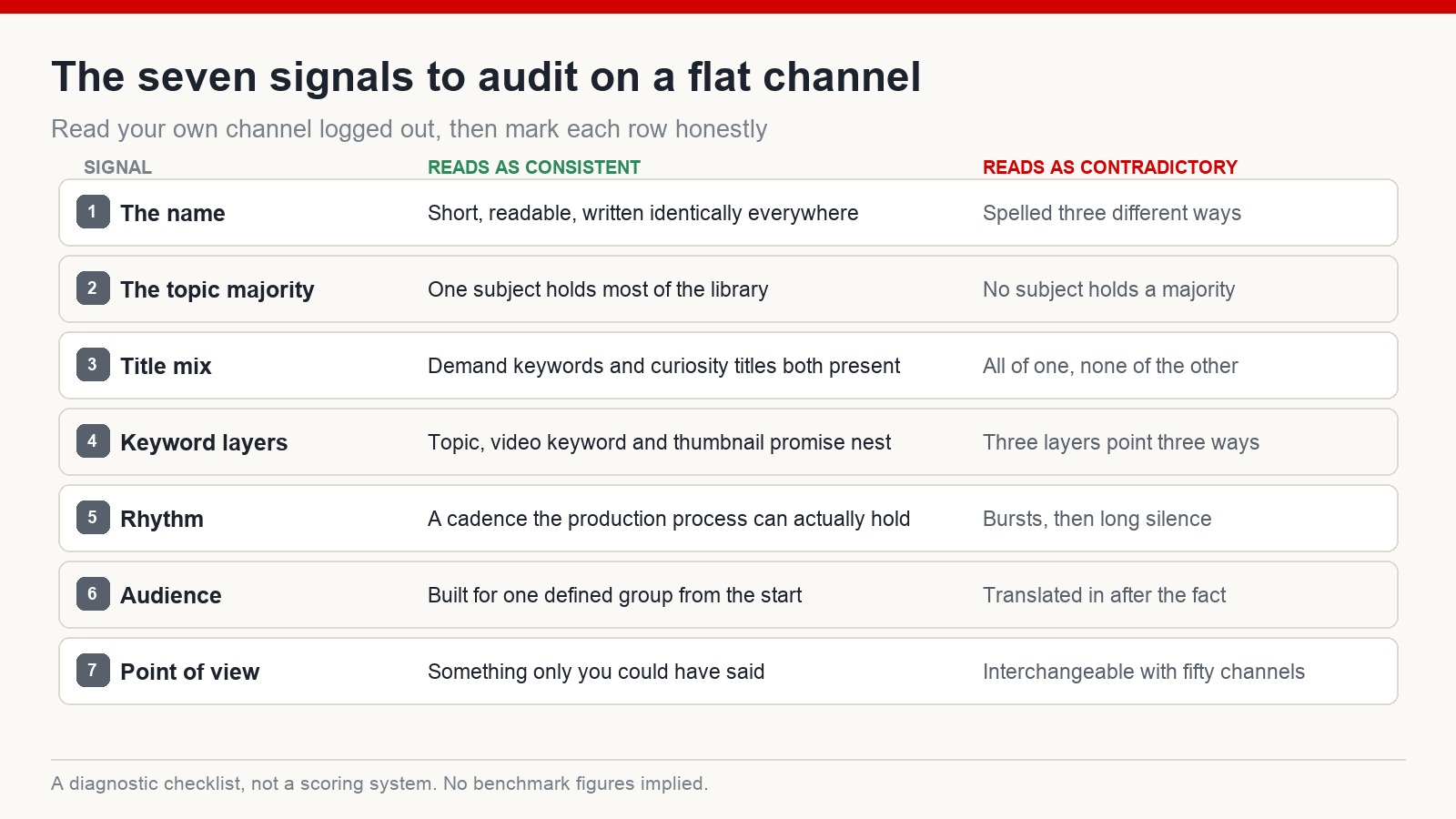
1. The name
A channel name does two jobs. It makes you memorable, and it gives an early hint about subject matter. Three approaches work: a clean brand word on its own, a brand word plus a subject tag, or a name built in the shape that already works in your category without imitating any specific channel.
Whichever you pick, keep it short – two or three words – readable at thumbnail size, and written identically everywhere. Capitalising it one way on YouTube and another way elsewhere is a small thing, but small inconsistencies are exactly what make a project look temporary.
2. The topic majority
Sort your videos by views and then ignore the ranking for a moment. Instead, group all your uploads by subject and count. Whatever holds the majority is what your channel is, regardless of what you intended it to be.
This is the majority principle, and it is the single most common place a stalled channel breaks. Creators believe they run a channel about one thing while the upload log says something else entirely.
3. Titles doing two different jobs
Titles split into two families and they are not interchangeable. Demand keywords answer a question somebody is actively typing – the phrasing is plain, and the payoff is steady traffic over a long period. Curiosity titles work on an open loop and tend to earn a higher click-through rate in the feed, but they decay faster.
A channel built entirely on curiosity titles has no floor: when the feed cools, traffic goes with it. A channel built entirely on demand keywords rarely gets picked up by the feed at all. Audit the ratio.
4. The three keyword layers under one video
Any video that performs is usually carrying three layers at once. The broadest is the topic – the category the channel lives in. The middle layer is the video keyword, the specific thing this upload answers. The narrowest is the thumbnail promise, which is written for a human eye rather than a search box.
If those three layers point in three directions, the video reads as noise. If they nest cleanly, one video reinforces the channel instead of diluting it.
5. Rhythm
Consistency is doing less work than people think in terms of algorithmic favour, and more work than people think in terms of your own decision-making. A predictable rhythm forces a repeatable production process, and a repeatable process is the only thing that survives a bad month.
6. Who the channel is actually for
Content aimed at a broad international audience and content aimed at one specific group are different products, not the same product in different clothes. If you are building for English-speaking viewers, everything from example choice to pacing has to be built for them from the start rather than translated in afterwards.
7. How much of it is machine-made
Assistive tools are genuinely useful for research, drafting, translation and editing. What they cannot supply is a point of view. If nothing in your videos could only have come from you – no experience, no opinion, no judgement about what matters – viewers have no reason to come back for the next one, and that shows up in retention long before it shows up in views.
Reading the audit
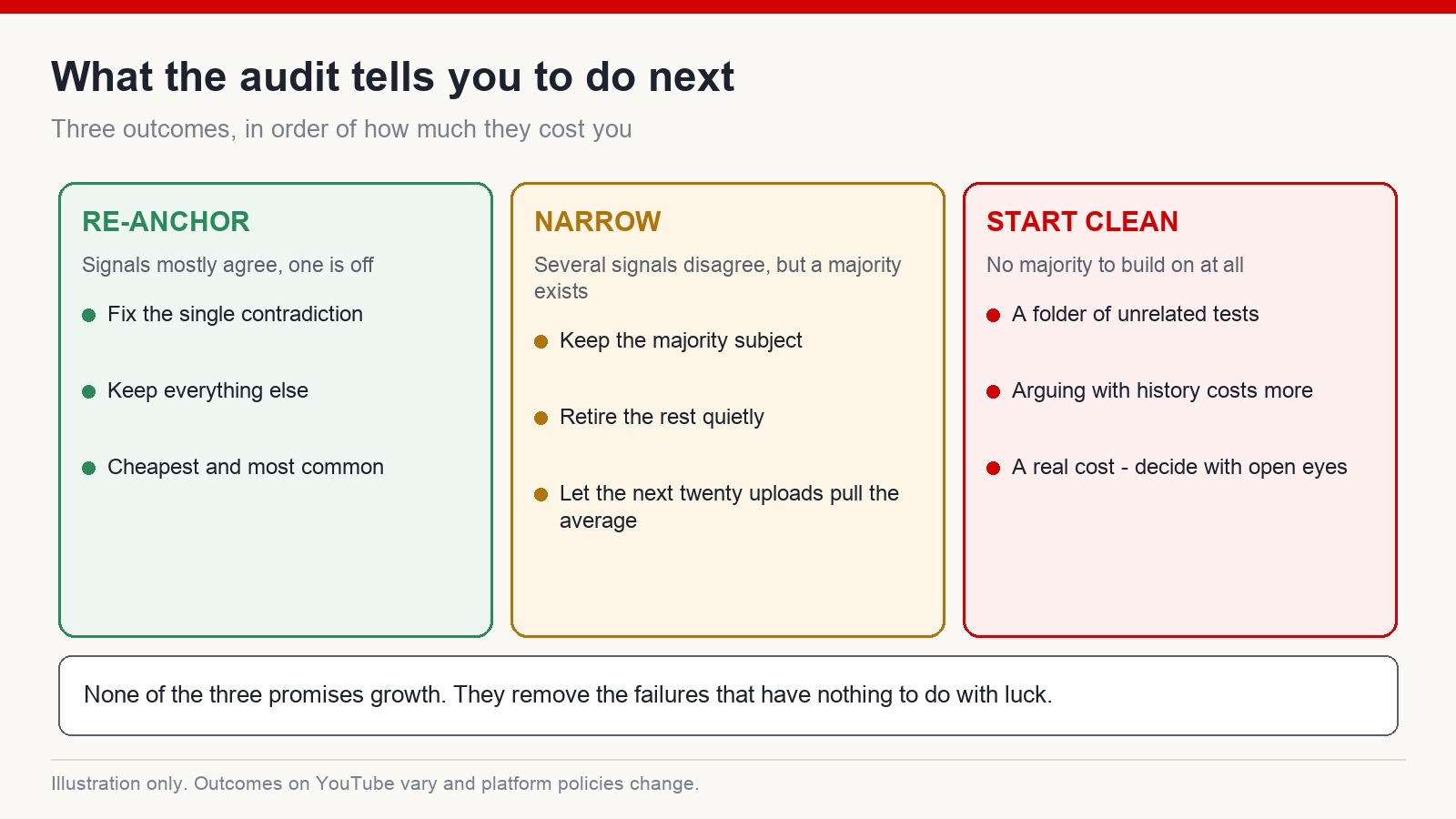
Once you have gone through all seven, you usually end up in one of three places.
Re-anchor. The signals mostly agree and one is off. Fix the one. This is the common case and the cheapest to act on.
Narrow. Several signals disagree, but a real topic majority already exists somewhere in your library. Keep that majority, retire the rest, and let the next batch of uploads pull the average back toward one subject. You do not need to delete anything – you just need the next twenty uploads to be unambiguous.
Start clean. There is no majority to build on, and the library reads as a folder of unrelated experiments. It is often faster to open a new channel with a decided topic than to argue with an existing history. That is a real cost, so it is worth being honest that it is sometimes the correct decision.
A publishing pattern that keeps the signals stable
A rotation many creators use is roughly four foundation videos to one topical video. The foundation uploads hold the channel’s definition steady. The topical one gives the channel a chance to be found by people who are not looking for you yet.
The ratio matters less than the principle behind it: the majority of your output defines you, so spend the majority of your output deliberately.
What the audit will not tell you
It will not tell you when growth arrives. Nobody can honestly tell you that. Results vary enormously between topics and markets, policies change, and a niche that was wide open six months ago can be crowded now.
What the audit does is remove the failure modes that have nothing to do with luck. A channel that is legible, consistent and pointed at a defined audience is not guaranteed anything – but it is at least being judged on its content rather than on its confusion.
Where this leaves you
If you have uploaded thirty videos into silence, resist the instinct to make it thirty-five this week. Spend an afternoon reading your channel as an outsider would, find where it contradicts itself, and fix one contradiction properly.
Do not try to build a single video that takes off. Build a channel that can carry two hundred videos without ever confusing anyone about what it is.
Frequently asked questions
Does the channel name really affect discovery?
Indirectly. A clear, consistent name helps people recognise and remember you, and it gives an early hint about subject matter. Content, topic consistency and viewer satisfaction do far more of the work.
Should I just chase whatever is trending?
Not as a strategy. Trend-led videos can bring a spike, but they rarely build an audience that returns. A mix of durable, evergreen content with a smaller share of topical content tends to hold up better over time.
Can AI tools replace the creator?
They can carry a great deal of the production – research, outlines, drafts, translation, editing. They cannot supply the perspective that makes one channel different from the fifty others covering the same subject, and that difference is usually what viewers are actually subscribing to.
How long before I judge a channel as stalled?
Long enough for the signals to be consistent in the first place. If the last twenty uploads have been scattered across unrelated topics, the channel has not really been tested yet – the topic has.
If you want to go deeper on building for an English-speaking audience, the full system is at mmoyoutube.com.